Jul 2026
AI SEO in 2026: A Founder’s Guide to Ranking and Earning Citations in Large Language Models
Most AI SEO guidance targets agencies. This summary explains its relevance for small businesses, identifies tasks to automate, and outlines steps to gain citations in AI-generated answers.

Anastasiia Bielousova

The two things "AI SEO" means
AI SEO is commonly defined in two main ways.
The first definition involves using AI to perform SEO tasks, such as drafting title tags, grouping keywords, summarizing competitor content, and generating schema markup. AI increases the efficiency of these standard optimization activities.
The second definition focuses on optimizing your business to be cited by AI systems. For example, when users ask ChatGPT for company recommendations or Perplexity for the best tools, algorithms determine which sources to mention. This process, known as generative engine optimization, answer engine optimization, or AI SEO, is fundamentally different from the first definition.
Many leading guides conflate these two approaches, which is problematic because each requires different tactics, tools, and budgets. The first approach streamlines tasks for efficiency, while the second emphasizes visibility by ensuring your business is mentioned in new decision-making environments.
This confusion often leads small businesses to make costly mistakes. For example, they may buy an AI writing tool expecting greater visibility in ChatGPT, or hire a generative engine optimization specialist when a few hours of targeted work and an effective prompt would have sufficed.
This guide covers two main topics. Part one outlines the workflow, clarifying which tasks to delegate to AI, which to retain, and how to cut the time for a first blog post from eight hours to ninety minutes. Part two reviews citation practices, explains how retrieval systems select sources and determine extractable content, and provides a ten-minute test to check if AI is already recommending your work.
What AI SEO is (and what it isn't)
AI SEO does not influence search rankings.
Google does not prioritize content created with AI or labeled as "AI-optimized." Using AI offers no special advantage or consideration in search results.
Many small business owners mistakenly believe otherwise, and this misconception is seldom addressed directly. Google’s guidance prioritizes quality and usefulness over how content is produced. Both AI-generated and human-written content are evaluated by the same standards. A mediocre page remains mediocre, regardless of its source.
The change is not in how content is evaluated, but in how and where answers are delivered.
What actually changed
Traditional search engines index and rank pages, presenting users with a list of links to choose from.
AI-powered search retrieves and synthesizes information by extracting passages from multiple sources, assembling a comprehensive answer, and citing those sources. Your content now competes to be cited as a source in these answers, rather than for a specific ranking.
This shift leads to more zero-click searches, where users get information without visiting your site. For informational queries, traffic patterns are already changing. Not recognizing this may cause you to misinterpret analytics as a decline, when it actually reflects evolving user behavior.
Adjust your expectations: for some topics, the goal is now to be cited rather than to generate clicks. Being mentioned in an AI-generated answer can increase brand recognition, which may later lead to direct traffic and branded searches. Although this is harder to measure, its impact remains significant.
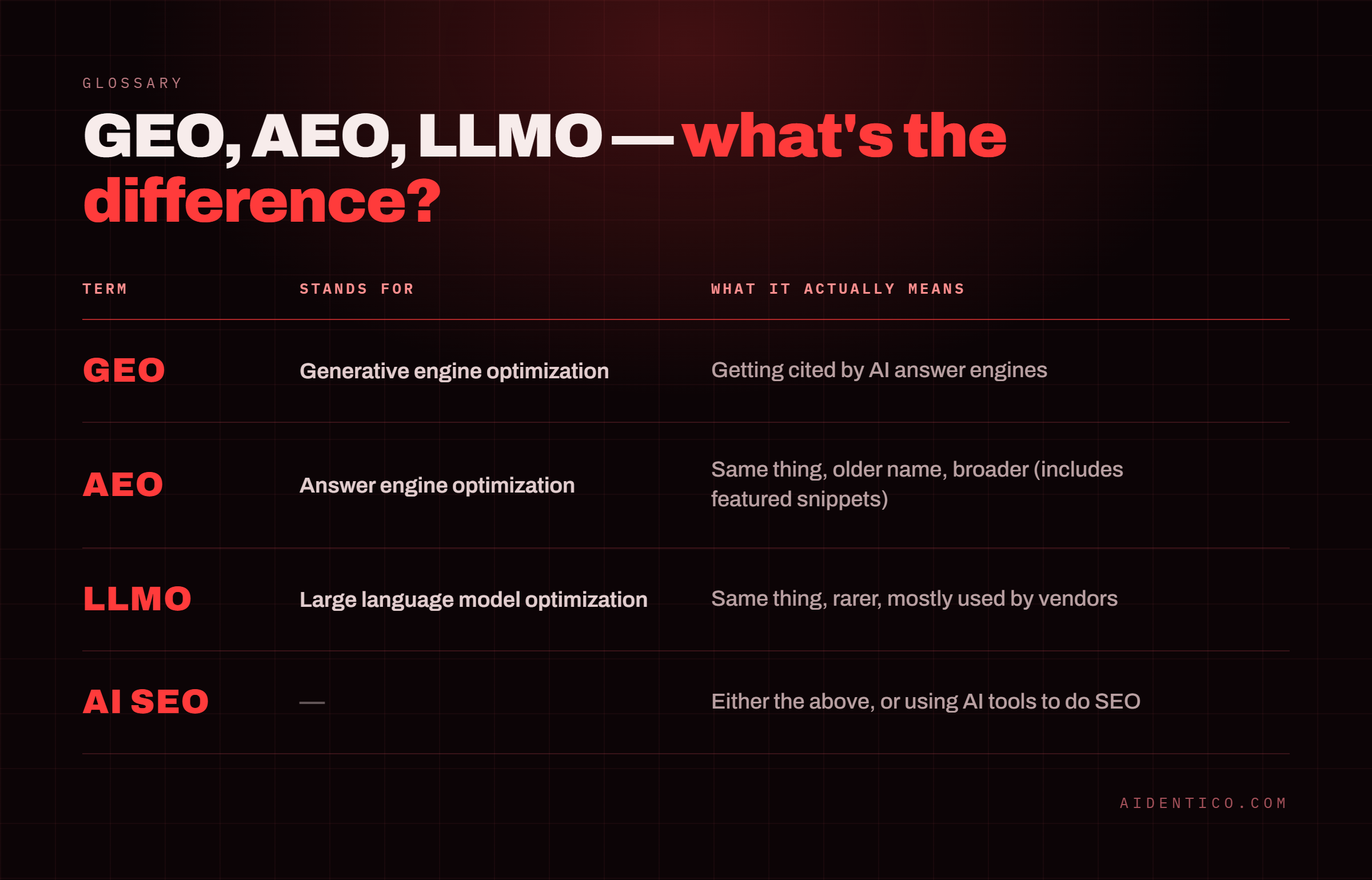
If a vendor claims their GEO methodology is fundamentally different from AEO, request specific details. In most cases, there are no significant differences.
Part One: Accelerating SEO with AI
What AI is reliably good at
AI excels at repetitive tasks with clear, verifiable outputs. Tasks that can be reviewed in under thirty seconds are ideal for AI.
- Metadata: Generate bulk title tags and meta descriptions that meet character limits.
- Alt text: Submit images to receive accurate descriptions.
- Keyword clustering: Upload keyword lists to quickly receive organized topic groups.
- Content outlines: Structure posts before drafting.
- Competitor summaries: Analyze ranking pages to obtain section-by-section summaries.
- SERP review: Summarize similarities and gaps in the top ten results.
- Schema generation: Create JSON-LD for Article, FAQ, LocalBusiness, and related types.
- Internal link suggestions: Identify optimal links between new content and your existing sitemap.
These tasks do not require business-specific judgment but are often time-consuming.
What AI is bad at
- Business nuance. AI does not fully understand your key customer segments or the specific meanings of industry terms. It may also miss sensitivities, such as how competitor comparisons impact partnerships.
- Factual accuracy. This is the greatest risk. AI may generate statistics, such as "73% of consumers now start their search in AI tools," without credible sources. These statements may appear authoritative but can be challenged by prospects or exposed as inaccurate by journalists. One fabricated figure can undermine trust more than several well-written paragraphs can build.
- Brand judgment and content relevance. AI may create content that does not reflect your brand or meet your audience’s needs.
- Guideline. Use AI to draft, organize, and summarize content. You are responsible for ensuring accuracy, perspective, and publication decisions.
A realistic AI SEO workflow for one person
Time comparison: Writing a first blog post manually typically takes founders 6 to 10 hours. With this AI workflow, the same post can be completed in 60 to 120 minutes. The main value of AI for SEO is efficiency, allowing you to produce similar content in less time and at lower cost.

Part Two: Getting Cited by AI Systems
How LLMs pick sources
When you ask ChatGPT or Perplexity a question that requires current information, the system retrieves relevant passages to generate its answer. Only this retrieved content can be cited.
This leads to two important considerations.
First, retrieval happens at the passage level, not the page level. A concise 600-word page that answers the question directly is more likely to be cited than a 4,000-word guide with the answer buried within. Clarity and quotability are more valuable than comprehensiveness.
Second, entities are more important than keywords. These systems prioritize companies, people, products, places, and their relationships. Inconsistent naming, such as using different business names or job titles across platforms, creates ambiguity and reduces the chance of accurate citation.
Five things that make content extractable
1. State the direct answer within the first 100 words, then add supporting details as needed. This approach, known as the inverted pyramid in journalism, is also preferred by retrieval systems for its clarity.
2. Maintain a clear heading structure with one H1, logical H2s, and properly nested H3s. Headings help systems define passage boundaries.
3. Use original data or specific figures. General statements like "most businesses" are less likely to be cited, while precise data such as "Our 37 client projects averaged 14 weeks to first AI citation" increases the likelihood of citation. Specificity attracts citations.
4. Implement schema markup, including Organization, Article, and FAQPage at a minimum. Structured data helps systems understand your content.
5. Ensure consistent entity naming across all platforms, including your website, LinkedIn, directories, and press mentions. Consistency in company names, founder names, and job titles is essential but often overlooked.
Where AI Systems Search Beyond Your Website
Many founders are surprised to learn that most information about their business comes from sources beyond their own website.
- Reddit is a key source, as users often share candid product feedback.
- YouTube transcripts are available as text, allowing video content to rank in search results where written content may not.
- Platforms like G2, Capterra, and Clutch offer structured, comparative reviews and are trusted for 'best X' searches.
- Industry directories are especially valuable for local and niche categories.
- Wikipedia and Wikidata are essential for entity recognition if your business qualifies for inclusion.
In traditional search, off-site presence mainly provided backlinks to signal credibility. In AI-driven search, these sources are used directly as references. For example, a Reddit thread praising your product may be cited without linking to your site. While you cannot control this, you can ensure your business is present on frequently referenced platforms.
How to check if you're being cited
This process takes ten minutes, is free, and requires no additional tools. Open ChatGPT, Perplexity, Gemini, and Google Search with AI Overviews. Replace the placeholders in the prompts below with your category and location.
1. What are the best [your category] companies for [your customer type]?
2. I run a [customer's business type] and need [the problem you solve]. Who should I talk to?
3. [Your company name]: what do they do and who are they for?
4. Compare [your company] and [your main competitor].
5. What should I look for when choosing a [your category] provider?
For each prompt, note whether your company is mentioned, which sources are cited, and any inaccuracies in the information.
Prompts 1 and 2 show whether your company is considered a top option. Prompt 3 assesses if your business is accurately understood. Prompt 4 clarifies your positioning relative to competitors. Prompt 5 highlights sources that define your category's buying criteria; these are the pages where you should seek mentions.
Repeat this process monthly. Results may vary between sessions, so avoid drawing conclusions from a single test. Tracking your findings over three months will provide more insight than any dashboard.
The AI SEO Tool Landscape: What Small Businesses Actually Need
AI SEO tools fall into four categories, but most small businesses need only two.
Research and clustering tools offer keyword data, SERP analysis, and competitor insights. Most paid tools include these features, but for businesses publishing up to four posts per month, free tiers are usually sufficient.
General-purpose AI models typically support content creation. Dedicated SEO writing tools with templates and scoring are useful for high-volume publishing but unnecessary if you publish fewer than ten posts per month.
Technical audits detect crawl errors, site speed issues, and schema problems. For small sites, a quarterly audit is sufficient, and free crawlers generally meet these needs.
AI visibility tracking monitors your presence in AI-generated answers across platforms. This tool is valuable once you actively pursue citations; until then, manual prompt testing is sufficient.
Use one research tool and one general AI model. Add visibility tracking only when you have a citation strategy to measure. Consider additional tools only if a specific need arises. Be cautious of any tool claiming to "get you into ChatGPT." No tool can guarantee placement in AI-generated answers. Tools can measure and assist, but results depend on your content, entities, and off-site presence.
Common AI SEO mistakes
- Publishing unedited AI drafts produces content that is rarely cited or remembered. Editing is essential to ensure your content is valuable.
- Prioritizing quantity over specificity reduces impact. A few unique, insightful posts are more valuable than many generic ones. Search systems favor original, quotable content.
- Neglecting schema is a missed opportunity. Implementing schema is straightforward and clarifies your content’s purpose. Failing to use it forfeits a clear advantage.
- Relying on GEO instead of technical SEO is ineffective. AI systems need websites that are properly crawled and indexed. Features such as FAQ blocks cannot offset slow sites or broken canonicals. Technical fundamentals are now essential.
- Failing to measure results limits your ability to assess effectiveness. Without tracking AI mentions, you cannot gauge success. A monthly prompt test takes ten minutes and provides valuable insights. Recording these results offers a competitive advantage.
Conclusion
AI SEO uses established methods to improve efficiency and automate customer interactions through question-and-answer platforms.
Begin with the workflow, which typically recoups its cost in time saved within the first month. Next, complete the five-prompt test to evaluate how AI represents your business. This ten-minute process provides a clear starting point.
If you prefer a managed solution, our team can oversee the technical foundation, entity optimization, content development, and monthly citation reporting. You may also schedule a call with Aidentico for a personalized recommendation.
FAQ
Will AI replace SEO?
No. AI changes how search results are delivered, but people will continue to search. AI automates manual SEO tasks such as metadata, clustering, and drafting. However, strategy, judgment, and market knowledge remain human responsibilities. Businesses that leverage AI for SEO will outperform those that do not.
Is AI-generated content penalized by Google?
No, not for being AI-generated. Google evaluates content based on quality and usefulness, regardless of how it is created. Penalties are applied to low-value content published at scale to manipulate rankings. While AI can produce such content, penalties address low quality, not the use of AI.
How much does AI SEO cost for a small business?
DIY AI SEO typically costs $400 to $600 per month for tools, plus four to six hours of your time. Hybrid arrangements with a freelancer range from $500 to $1,500 per month. Full-service agencies usually start at $1,500 to $3,500 per month, with most small business budgets falling between $2,000 and $5,000.
How do I get my business mentioned in ChatGPT?
Ensure your business is easily found and consistent online. Publish content that answers specific questions within the first 100 words. Add Organization and FAQ schema, keep your company name and details identical across all platforms, and build a presence on frequently referenced sources such as Reddit, YouTube, and review platforms like G2.
Is AI SEO worth it for a local business?
Often yes, because local queries align with the questions people ask AI assistants. For example, "Best dentist near me who takes my insurance" is a typical conversational query. Local businesses succeed by maintaining consistent NAP data, using LocalBusiness schema, keeping active review profiles, and managing directory listings. This work is generally less costly than competing for national terms.
What's the difference between SEO and GEO?
SEO aims to rank in a list of links. GEO, or generative engine optimization, focuses on being cited within AI-generated answers. SEO rewards comprehensive pages, while GEO values quotable passages and clear entities. Both share a technical foundation, so GEO should be viewed as an extension of SEO, not a replacement.
.avif)
.jpg)
.jpg)
.jpg)