
AI SEO Services for Top Google Rankings and AI-Generated Answers
Search has evolved, with many users now receiving answers directly from AI platforms such as AI Overview, ChatGPT, or Perplexity, often without visiting websites. Our AI SEO services enhance your organic rankings and increase the likelihood that your brand is cited in AI-generated responses. We are an AI engineering firm specializing in SEO, rather than an SEO agency that relies on standard AI tools.
.avif)
What is AI SEO?
AI SEO uses artificial intelligence to enhance search performance and optimize websites for discovery, credibility, and citation by AI search engines.
It includes two main workstreams:
- AI-accelerated traditional SEO applies AI and custom agents to keyword and entity research, technical audits, content gap analysis, schema generation, and rank monitoring.
- AI search visibility covers answer engine optimization (AEO), which structures content as direct, extractable answers, and generative engine optimization (GEO), which maintains consistent brand and entity signals across sources used by AI engines.
Together, these approaches address two key buyer touchpoints: traditional organic rankings in Google and Bing, and citations within Google AI Overviews, Google AI Mode, Chat GPT, Perplexity, Gemini, and Copilot.
AEO optimizes on-page content to help search engines extract direct answers, while GEO enhances external signals to establish your brand’s credibility.
These strategies function at different levels:
- AEO (Answer Engine Optimization) targets on-page elements, including answer-first paragraphs, clear question headings, FAQ and Article schema, and a logical information hierarchy. This structure enables search engines to extract content efficiently.
- GEO (Generative Engine Optimization) is primarily off-page. It requires consistent entity descriptions across your website, profiles, directories, and press, along with third-party mentions and corroborating sources. This approach positions your brand as the consensus answer.
AEO increases the chances your content will be quoted, while GEO influences whether your brand is selected over competitors. Relying on only one approach limits results: either extraction without authority or authority that search engines cannot interpret.
Traditional SEO optimizes entire pages for ranking, while AI SEO targets specific passages and entities for retrieval and citation by ranking algorithms and language models.
This shift results in four key changes:
- Unit of work: The focus shifts from optimizing entire pages to targeting individual passages and entities.
- Content structure: Content is organized around answer-first sections and explicit questions, rather than keyword-driven long-form text.
- Technical emphasis: Structured data and consistent entity usage are now essential rather than optional.
- Measurement: Citation share and AI-driven referral traffic are measured alongside traditional metrics such as rankings and sessions.
A key challenge is that a page may keep its top ranking but lose significant click share if an AI Overview provides the answer above it. Traditional reporting methods may not capture this impact.
AI will not replace SEO, but it is changing SEO priorities. Search demand remains steady, but the interface has evolved.
The goal is now to become the source answer engines reference, rather than just ranking for blue links.
Key changes include:
- Clicks per ranking are declining for informational queries that search engines answer directly. Therefore, ranking position is no longer the sole objective.
- Commercial and comparison queries still convert, as buyers visit your site to verify vendors before purchasing.
- Technical optimization and entity development are becoming more important, as answer extraction depends on machine-readable structure.
- Thin content is less effective, as engines now generate generic answers directly.
Sites with weak foundations, undifferentiated content, or inconsistent brand signals are likely to lose visibility. SEO remains essential, but the criteria for success are evolving.
We routinely submit a standardized set of your commercial queries to major answer engines and record the outcomes.
Each assessment includes:
- Whether you are cited and the location of the citation within the answer
- How you are described, including claims or categories assigned by the engine
- Which competitors are mentioned and the sources cited for each
- Which URLs the engine references to help identify opportunities for improvement
We assess Google AI Overviews, Google AI Mode, ChatGPT, Perplexity, Gemini, and Copilot. By running the same query set each month, we convert anecdotal observations into a measurable citation share-of-voice baseline and track which content changes improve visibility.
Google’s guidance focuses on low-value content, not automation.
Unedited AI content often ranks poorly because it lacks first-hand experience, original data, specificity, and the clear perspective required by E-E-A-T.
Our approach to AI use includes:
- We use AI for research, SERP and competitor analysis, entity extraction, outline structuring, schema generation, and identifying gaps in large content sets.
- Human contributors develop arguments, provide examples and original data, apply judgment, and complete final editing.
Publishing large volumes of machine-generated pages can harm site performance. When AI supports research and structuring under human authorship, it enhances both quality and efficiency.
Technical and structured data enhancements may yield results within weeks.
Ranking improvements typically take three to six months, depending on domain authority and competition.
The general timeline is as follows:
- Weeks 2–6: Complete crawl, indexation, and schema updates. Early gains may be seen for long-tail and question-based keywords.
- Months 2–4: AI citations are updated as search engines re-crawl and reprocess content. These updates typically occur more frequently than ranking changes.
- Months 3–6: Mid-difficulty commercial keywords may start to improve.
- Months 6–9 and beyond: Competitive head terms may improve if the site has strong authority and supporting assets.
Be cautious of anyone promising first-page rankings for competitive terms within 30 days. Although AI-driven visibility may increase more quickly than rankings, meaningful results still require time.
AI SEO uses artificial intelligence to enhance search performance and optimize websites for discovery, credibility, and citation by AI search engines.
It includes two main workstreams:
- AI-accelerated traditional SEO applies AI and custom agents to keyword and entity research, technical audits, content gap analysis, schema generation, and rank monitoring.
- AI search visibility covers answer engine optimization (AEO), which structures content as direct, extractable answers, and generative engine optimization (GEO), which maintains consistent brand and entity signals across sources used by AI engines.
Together, these approaches address two key buyer touchpoints: traditional organic rankings in Google and Bing, and citations within Google AI Overviews, Google AI Mode, Chat GPT, Perplexity, Gemini, and Copilot.
AEO optimizes on-page content to help search engines extract direct answers, while GEO enhances external signals to establish your brand’s credibility.
These strategies function at different levels:
- AEO (Answer Engine Optimization) targets on-page elements, including answer-first paragraphs, clear question headings, FAQ and Article schema, and a logical information hierarchy. This structure enables search engines to extract content efficiently.
- GEO (Generative Engine Optimization) is primarily off-page. It requires consistent entity descriptions across your website, profiles, directories, and press, along with third-party mentions and corroborating sources. This approach positions your brand as the consensus answer.
AEO increases the chances your content will be quoted, while GEO influences whether your brand is selected over competitors. Relying on only one approach limits results: either extraction without authority or authority that search engines cannot interpret.
Traditional SEO optimizes entire pages for ranking, while AI SEO targets specific passages and entities for retrieval and citation by ranking algorithms and language models.
This shift results in four key changes:
- Unit of work: The focus shifts from optimizing entire pages to targeting individual passages and entities.
- Content structure: Content is organized around answer-first sections and explicit questions, rather than keyword-driven long-form text.
- Technical emphasis: Structured data and consistent entity usage are now essential rather than optional.
- Measurement: Citation share and AI-driven referral traffic are measured alongside traditional metrics such as rankings and sessions.
A key challenge is that a page may keep its top ranking but lose significant click share if an AI Overview provides the answer above it. Traditional reporting methods may not capture this impact.
AI will not replace SEO, but it is changing SEO priorities. Search demand remains steady, but the interface has evolved.
The goal is now to become the source answer engines reference, rather than just ranking for blue links.
Key changes include:
- Clicks per ranking are declining for informational queries that search engines answer directly. Therefore, ranking position is no longer the sole objective.
- Commercial and comparison queries still convert, as buyers visit your site to verify vendors before purchasing.
- Technical optimization and entity development are becoming more important, as answer extraction depends on machine-readable structure.
- Thin content is less effective, as engines now generate generic answers directly.
Sites with weak foundations, undifferentiated content, or inconsistent brand signals are likely to lose visibility. SEO remains essential, but the criteria for success are evolving.
We routinely submit a standardized set of your commercial queries to major answer engines and record the outcomes.
Each assessment includes:
- Whether you are cited and the location of the citation within the answer
- How you are described, including claims or categories assigned by the engine
- Which competitors are mentioned and the sources cited for each
- Which URLs the engine references to help identify opportunities for improvement
We assess Google AI Overviews, Google AI Mode, ChatGPT, Perplexity, Gemini, and Copilot. By running the same query set each month, we convert anecdotal observations into a measurable citation share-of-voice baseline and track which content changes improve visibility.
Google’s guidance focuses on low-value content, not automation.
Unedited AI content often ranks poorly because it lacks first-hand experience, original data, specificity, and the clear perspective required by E-E-A-T.
Our approach to AI use includes:
- We use AI for research, SERP and competitor analysis, entity extraction, outline structuring, schema generation, and identifying gaps in large content sets.
- Human contributors develop arguments, provide examples and original data, apply judgment, and complete final editing.
Publishing large volumes of machine-generated pages can harm site performance. When AI supports research and structuring under human authorship, it enhances both quality and efficiency.
Technical and structured data enhancements may yield results within weeks.
Ranking improvements typically take three to six months, depending on domain authority and competition.
The general timeline is as follows:
- Weeks 2–6: Complete crawl, indexation, and schema updates. Early gains may be seen for long-tail and question-based keywords.
- Months 2–4: AI citations are updated as search engines re-crawl and reprocess content. These updates typically occur more frequently than ranking changes.
- Months 3–6: Mid-difficulty commercial keywords may start to improve.
- Months 6–9 and beyond: Competitive head terms may improve if the site has strong authority and supporting assets.
Be cautious of anyone promising first-page rankings for competitive terms within 30 days. Although AI-driven visibility may increase more quickly than rankings, meaningful results still require time.
Benefits of AI SEO and GEO Services
AI-driven SEO and generative engine optimisation deliver two main benefits: improved Google rankings and increased citations in the growing number of AI-generated responses.
AI SEO optimises your site for both search algorithms and language models. Strong technical foundations, structured data, and consistent entity signals make your content accessible. Traditional organic SEO continues to drive buyer clicks. Together, these approaches increase visibility across Google, Bing, AI Overviews, ChatGPT, Perplexity, and Gemini. Success is measured by pipeline growth, not impressions.
AI SEO & GEO Strategy
We evaluate your technical foundation, identify revenue-driving keywords and questions, and establish your AI engine visibility baseline prior to engagement.
- AI Search Visibility Baseline: We monitor your citations across AI Overviews, ChatGPT, Perplexity, and Gemini, and identify competitors in your positions.
- Technical and Entity Audit: We detect crawl, schema, and brand consistency issues that hinder engines from extracting, trusting, or citing your content.
- Revenue-Mapped Keyword Strategy: We prioritize keyword clusters that generate qualified leads over those that only boost traffic metrics.

AI SEO & GEO Launch
We provide technical enhancements, structured data, and content to improve search rankings and secure AI citations.
- Structured Data and Technical Fixes: We implement JSON-LD schema, resolve crawl and indexation issues, and optimize page structure to help search engines extract relevant information.
- Answer-First Content Production: We develop topic clusters designed for inclusion in featured snippets, Google AI Overviews, and responses from ChatGPT and Perplexity.
- Citation Tracking: Our monthly reports include AI citations, rankings, and pipeline metrics so you can monitor which efforts generate revenue.
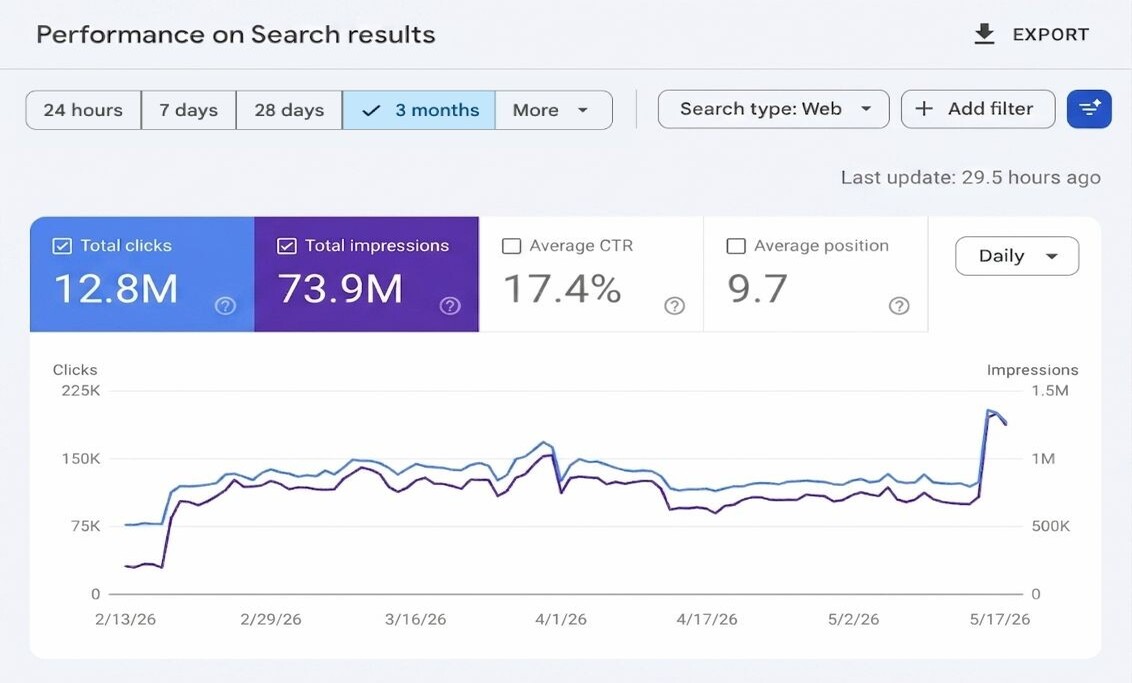
Achieving 167% More Clicks in the AI Search Era
We increased daily clicks from 75,000 to 200,000 in three months for a health and wellness brand by strengthening Google Search visibility and expanding across AI-powered search experiences, including AI Overviews.by combining traditional Google Search visibility with a stronger presence in AI-powered search experiences, including AI Overviews.
Organic Clicks (+167%)
Search Impressions (+650%)
Average Position (+43%)
How We Build Your AI SEO & GEO
01
AI SEO & GEO Strategy
Our SEO strategists audit your site, evaluate your visibility across six AI engines, and create a prioritized roadmap that targets revenue growth instead of traffic volume.
02
Technical SEO & Structured Data Implementation
Our engineers address crawl, indexation, and Core Web Vitals issues, implement JSON-LD schema across all templates, and align entity signals to help search and answer engines accurately extract and trust your content.
03
Content, Citations & Ongoing Optimization
We publish answer-focused content, enhance third-party signals valued by generative engines, and monitor citations monthly across AI Overviews, ChatGPT, Perplexity, and Gemini. Our reporting links visibility directly to your sales pipeline.
7+




.avif)



Technologies, that we use






.svg)







Take your business to the next level with AIdentico
We’re here to help you move forward faster! Let’s explore your goals together and find the smartest way to achieve them with AI-driven solutions.