Aug 2026
AI SEO Agents: A Smarter Way to Scale GEO, Traffic & AI Visibility
An AI agent for AI SEO manages keyword, content, technical, and GEO workflows from start to finish. Review its automation capabilities, costs, and considerations for building versus buying.

Anastasiia Bielousova

Search underwent two major changes in eighteen months, yet most marketing teams adapted only once.
The first change was clear: Google introduced AI Overviews at the top of the results page. Semrush tracked their prevalence through 2025, noting an increase from 6.49% of queries in January to a peak of 24.61% in July, then stabilizing at 15.69% in November. This trend persisted despite fluctuations. The second, less visible change was more significant: a separate discovery layer emerged as users began asking commercial questions to ChatGPT, Perplexity, Gemini, and Claude, which now provide direct answers without a results page.
The workload to compete across both channels nearly doubled, but team sizes remained unchanged.
Most teams responded by purchasing additional software, leading to more dashboards, alerts, and exports, but manual work did not decrease. These tools improved issue identification but did not increase efficiency in resolving them. An AI agent for AI SEO is designed to address this gap.
This distinction is central to the article: tools recommend actions, but agents execute them.
This document is intended for budget approvers and outlines the systems, seven managed workflows, four current limitations, build-versus-buy recommendations, and a 90-day rollout plan to minimize site disruption.
What is an AI agent for SEO?
An AI agent for SEO is an autonomous system that plans and executes multi-step search optimization tasks. It collects live data, makes decisions, and implements changes across traditional search and AI answer engines without human intervention at each step.
Four key properties set an agent apart from other marketing tools.
It is goal-directed. You specify an outcome, such as "find and fix the technical issues costing us organic revenue this quarter," rather than providing a prompt. The agent then independently breaks this goal into actionable steps.
It uses tools. The agent connects through APIs or MCP to your existing stack, including Search Console, your crawler, CMS, rank tracker, and analytics. It reads live data instead of relying on standard data descriptions.
It works sequentially. The output of each step becomes the input for the next. For example, a keyword cluster informs a content gap analysis, which leads to a brief, then a draft, a published page, and finally a verification check.
It has memory. The agent records its actions, outcomes, and eliminated options, so each run is better informed than the last. This often-overlooked feature enables the agent to improve over time, while a chatbot starts fresh each session.
AI SEO agent vs. AI SEO tool vs. ChatGPT
Category confusion can be costly, as vendors often market all three as the same solution.
Below are the practical differences between an AI SEO agent, an AI SEO tool, and ChatGPT:
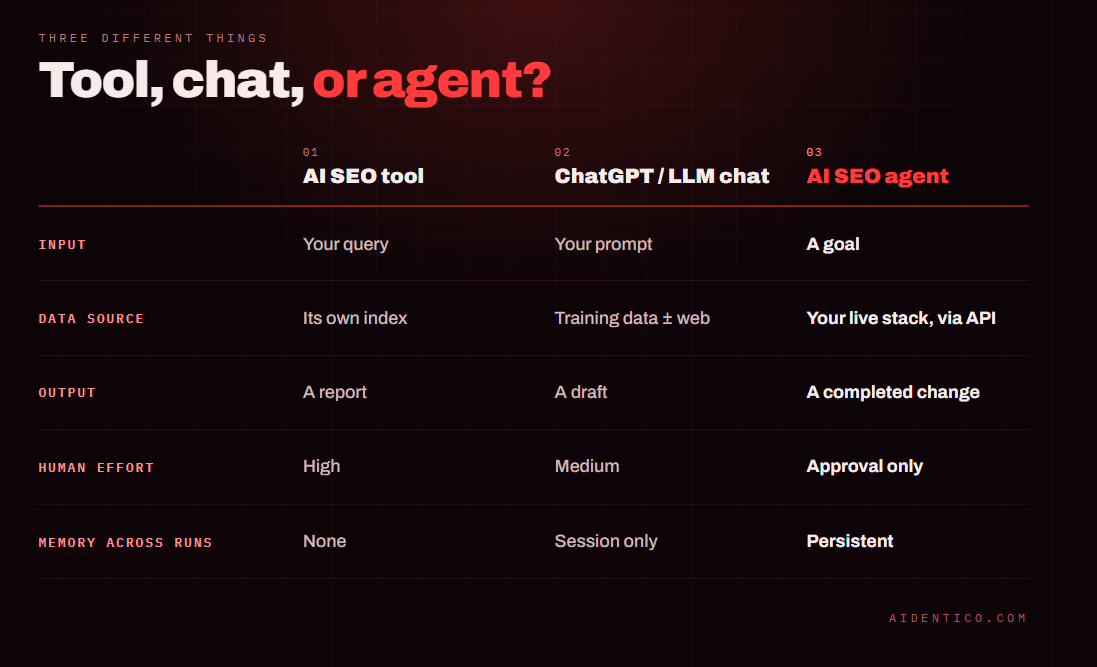
An AI SEO tool with a chat interface remains just a tool. If its recommendations require manual implementation, your workflow is not automated; only task creation is faster. While this can add some value, it does not fundamentally change your cost structure.
Clarifying the distinction between AI SEO and GEO
"AI SEO" now refers to two distinct functions. Confusing them can result in poor investment decisions.
The first function is ranking, which means appearing in Google’s results, including AI Overviews. This is still traditional SEO, though it now requires extra formatting.
The second function is citation: being mentioned and linked when users ask ChatGPT or Perplexity for recommendations. This is generative engine optimization (GEO), also called AEO, and it works differently. There is no ranking to track; instead, you monitor your presence, context, and competitors across engines, with responses that change each time.
Agents are essential for the second task because measurement involves running identical prompts across multiple engines and recording the results. This repetitive, high-frequency work should not be done manually, yet most teams still handle it this way or ignore it altogether.
Seven SEO tasks where an AI agent outperforms a person
While not all SEO tasks are ideal for automation, these seven workflows deliver the fastest results.
1. Reporting and anomaly alerting
The agent consolidates Search Console, analytics, rank data, and citation tracking into one scheduled report. It escalates issues only when a metric exceeds your defined threshold. You determine which anomalies require attention. Automating weekly reports saves time otherwise spent on infrequently reviewed documents. This workflow often delivers the quickest return and is an excellent starting point.
2. Content gap and refresh triage
The agent continuously audits your content library, prioritizes declining pages based on at-risk traffic instead of lost traffic, and drafts targeted updates for each page. You decide which refreshes align with commercial priorities.
The commercial rationale is clear: these pages already have authority and links, so recovering them requires minimal effort for significant potential return. Refreshing existing content is where agents add the most value, even before publishing new articles.
3. Internal linking at scale
The agent reviews all site pages to identify semantic relationships, recommends targeted internal links, and verifies their implementation.
A human reviews and approves anchor text on commercially sensitive pages. This workflow delivers a high effort-to-impact ratio in SEO but is often overlooked because of the manual effort required for large sites.
4. Technical SEO detection and triage
The agent crawls the site, classifies issues by likely revenue impact rather than generic severity, opens tickets in your system, and verifies resolution after deployment.
A human approves any template changes. Unlike standard crawlers that report thousands of issues, the agent prioritizes the most critical, files them, and ensures follow-up.
5. Keyword research and intent clustering
The agent collects raw keyword sets, clusters them by intent, scores them by business value rather than search volume, maps clusters to existing URLs, and flags cannibalization.
A human selects which clusters to pursue. This process saves time but closely matches the capabilities of existing tools.
The key advantage is that the output integrates directly into the next workflow step, rather than remaining in a spreadsheet.
6. Content optimization for both surfaces
The agent structures pages for optimal extraction by using direct-answer openings, a clear heading hierarchy, high factual density, and correct schema.
This approach differs from traditional on-page optimization. Language models cite specific passages, not entire pages. If a definition is buried in the content, it may not be quoted because models require clear, extractable statements. Optimizing for this requires a different writing style and automated checks at scale.
7. AI citation and brand-mention monitoring
The agent runs a fixed set of prompts across ChatGPT, Perplexity, Gemini, and Claude on a set schedule. It records whether your brand appears, the context, competing brands mentioned, and the sources each engine cites.
Automation is essential for managing this workflow. In GEO, the primary measurement challenge is volume, not analytical complexity. Running fifty prompts across four engines each week creates 200 manual queries, which is unsustainable. Automated agents can process these queries continuously and deliver trend analysis. For most companies, this benefit alone justifies the investment, as the alternative is losing visibility into a channel that is quietly transforming how buyers discover vendors.
A necessary caveat applies to all seven: agents reduce execution time but do not replace human judgment. Strategy, brand voice, editorial risk, competitive positioning, and stakeholder alignment remain human responsibilities. Any vendor claiming otherwise is making an unrealistic promise.
Common Limitations of AI SEO Agents
While most articles focus on capabilities, few address failure modes. Understanding these is critical for effective deployment.
Four issues are especially significant.
It hallucinates facts and invents citations. Language models generate plausible text, but plausible is not the same as true. An agent writing about your regulated industry will produce a confident statistic with a fabricated source unless you build verification into the chain. Anything with claims, figures, legal exposure, or competitive comparison needs human review. Treat this as a permanent design constraint, not a temporary limitation of current models.
It has no brand judgement. An agent does not know you cannot publish a comparison against that competitor, that your legal team killed that claim in March, or that your CEO has strong opinions about the word "solutions." It optimises for the objective you gave it. This is a problem when the real objective includes things nobody wrote down.
It automates bad data faster. If connected to outdated exports, incomplete crawls, or misconfigured analytics, they may make incorrect choices with confidence. Most deployment failures occur at the data layer. Prioritize auditing sources, fixing integrations, and defining what "live" means for each data feed. Allocate sufficient resources for these tasks.
Errors can compound throughout multi-step workflows. A single mistake early in the process may affect all subsequent steps, even if the final output appears correct. Address this with architectural solutions: implement checkpoints between phases, set confidence thresholds for escalation, and favor shorter workflows with human oversight over long autonomous processes.
A fifth issue concerns governance rather than capability. Granting an agent write access to your CMS introduces production risks if staged approvals, role-based permissions, and comprehensive audit logs are not in place. These controls are standard for any production system but are often overlooked in AI deployments because the software is perceived as a tool rather than a service account. These challenges should not deter the use of AI agents. Instead, they set the design requirements that separate successful deployments from those that lead to ongoing maintenance problems.
Build, buy, or partner: understanding the costs
There are three viable options. The best choice depends on your organization's specific requirements, not on general comparisons.
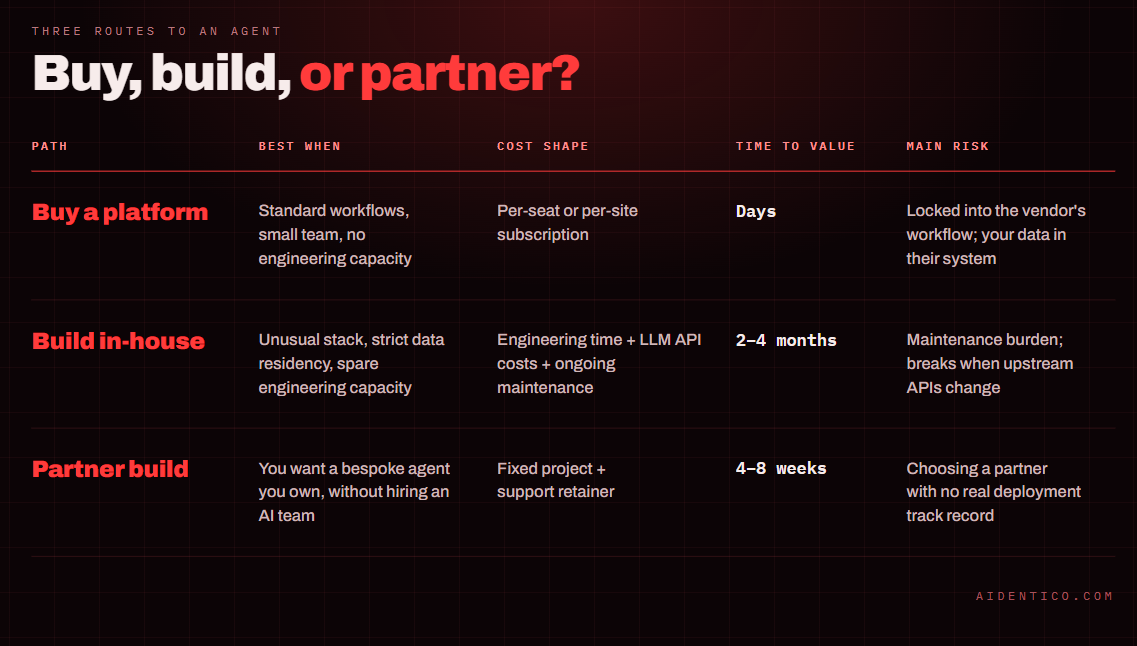
The in-house approach requires careful evaluation. Building a basic agent is quick, but maintaining it in production requires ongoing engineering resources to address API changes, rate limits, model deprecations, and data edge cases. Search Engine Land’s walkthrough of building SEO agents on n8n highlights these challenges, noting the platform’s immaturity and the risk of core updates disrupting workflows. This issue is common across the category. The primary cost is ongoing maintenance, not initial development.
Four questions that decide it:
- Is your workflow standard, or does your industry require specific adaptations? Regulated content, multi-market localization, and unique site architectures often require custom solutions.
- Can your data leave your infrastructure? If not, most SaaS solutions will not be suitable.
- Do you have engineering resources for an initial three-month build and ongoing maintenance? Consider the long-term commitment involved.
- Do you need to own the system, or is a vendor solution sufficient? Renting is often faster and less expensive, but this can change if the vendor adjusts pricing or their roadmap.
How to model the return
Do not rely solely on vendor ROI calculators. Use clear, independently verifiable calculations instead.
For each of the seven workflows above, estimate the monthly hours spent and multiply by the fully loaded cost. This is your current expenditure on tasks an agent could perform. Compare this to the build or license cost, LLM usage fees, and the required human review time. Be sure to include review time, as it is often overlooked.
Next, consider second-order benefits, which are often greater and harder to quantify. These include increased throughput for previously impossible tasks, such as continuous refresh triage, site-wide internal linking, and citation monitoring across multiple engines. These are not only cost savings but also new capabilities.
Most teams achieve payback on reporting and refresh tasks within the first quarter. Strategic workflows take longer but provide greater long-term value.
A 90-Day Rollout Plan That Avoids Failure
Teams often fail by launching a complex, multi-workflow agent directly into production, encountering unforeseen issues within two weeks, and then abandoning the project.
A phased rollout can help prevent these failures.
Days 1–30: Implement a single workflow in read-only mode.
Select the most frequent and lowest-risk workflow, such as reporting or technical triage.
Connect and thoroughly verify real data sources, as this step is essential for deployment. The agent should propose actions for human execution. Establish clear baseline metrics for evaluation, as subjective impressions are not sufficient for renewal decisions.
Days 31–60: Enable write access with approval gates.
Transition to staged execution, where the agent submits changes to a draft or staging state for human approval. Add the second and third workflows. Enable a logged audit trail for every change with clear attribution to quickly identify the reason for each modification.
By day 60, you should know which decisions the agent makes reliably and which it does not. Maintain approval gates for the latter. The goal is not full autonomy, but appropriate autonomy.
Days 61–90: Integrate workflows and implement governance, evaluation, and oversight (GEO) processes.
Link individual workflows into sequences such as audit, prioritize, draft, publish, and verify. Implement AI citation monitoring and allow several weeks to establish a meaningful baseline.
Conduct a thorough review to determine which tasks can be fully automated, which require ongoing oversight, and which the agent does not perform well. Some tasks will always remain in the third category.
Indicators of success include hours reclaimed per week, reduced time from issue detection to resolution, increased brand citations in monitored prompts, and a shorter content refresh cycle. If these metrics do not improve within 90 days, the underlying issue is usually with the data layer, not the agent.
Conclusion
There are three key takeaways.
AI answer engines have intensified search competition, yet most teams have not adapted accordingly. Recommendation software does not solve the main problem, which is not a lack of direction. Rather than investing in another platform, choose one workflow, connect it to real data, and validate your approach before scaling.
At Aldentico, we have deployed over 345 AI agents across retail, healthcare, legal, and professional services, including agents that manage SEO and GEO operations end to end. Our experience indicates that failures often stem from data layer issues, such as ungated write access or unnecessarily complex processes.
If you are deciding which workflows to automate or maintain manually, we encourage you to consult with us before making any purchases.
FAQ
What is an AI agent for AI SEO?
An AI agent for SEO is an autonomous system that plans and executes multi-step SEO tasks by gathering live data, making decisions, and implementing changes across platforms such as Google, ChatGPT, and Perplexity, without human intervention. Unlike traditional tools, it completes tasks instead of only recommending actions.
How is an AI SEO agent different from an AI SEO tool?
A tool generates a report in response to your query, requiring you to take further action. An agent receives a goal, connects to your live systems, executes multiple steps, and delivers a completed change. Tools create to-do lists; agents complete them.
Can an AI agent replace an SEO specialist?
No. Agents handle execution tasks such as crawling, clustering, triage, monitoring, and reporting. They do not manage strategy, brand judgment, stakeholder alignment, or editorial risk assessment. In practice, agents enable SEO specialists to focus on strategic work rather than diminishing the need for their expertise.
What SEO tasks should never be fully automated?
Tasks involving factual claims, regulatory considerations, or competitive comparisons require human review before publication. The same applies to changes affecting site templates. Maintain ongoing approval processes for these areas rather than treating them as temporary safeguards.
How do AI agents help with AI Overviews and ChatGPT citations?
AI agents serve two primary roles. They structure content for passage-level extraction so models can quote your material, and they monitor citation performance by running scheduled prompts across multiple engines, which is not practical to do manually at scale.
How much does an AI SEO agent cost?
Costs depend on the approach. Platforms usually charge a subscription per seat or site. In-house builds require engineering resources, ongoing LLM usage, and maintenance. Partner builds often involve a fixed project fee and a support retainer. In all cases, factor in the time needed for human review.
Can an AI agent connect to my existing SEO stack?
In most cases, yes. Major platforms such as Search Console, analytics tools, crawlers, rank trackers, and CMSs provide APIs that agents can access through standardized connection layers. Integration requires effort but is a well-understood and essential deployment task.
How long before an AI SEO agent shows results?
Operational benefits, such as time savings and faster fix cycles, typically appear within the first month for a single workflow. Ranking and citation improvements follow standard SEO timelines, usually one to two quarters, as the agent accelerates execution but does not change search engine behavior.
.avif)
.jpg)
.png)
.jpg)